
Years after the pandemic, Long COVID remains one of the most misunderstood and frequently denied conditions in disability insurance claims. Despite growing medical research and recognition from major health organizations, insurance companies continue to apply outdated standards and a skeptical approach to Long COVID claims.
If you’re struggling with debilitating Long COVID symptoms and your disability benefits have been denied or terminated, you’re facing an uphill battle—but you’re not alone.
The Long COVID Reality Insurance Companies Ignore
Long COVID, also known as Post-Acute Sequelae of SARS-CoV-2 infection (PASC), affects millions of Americans who continue experiencing significant symptoms months or years after their initial COVID-19 infection.
The New England Journal of Medicine affirmed in July 2024 that, “The risk of Post-Acute Sequelae of SARS-CoV-2 infection (PASC) remains substantial even among vaccinated persons who had SARS-CoV-2 infection in the omicron era.” Their peer-reviewed data is also supported by the Department of Veterans Affairs.
The condition manifests differently in each person, but certain symptom clusters have emerged as particularly disabling:
- Profound fatigue and post-exertional malaise (PEM): Not simple tiredness, but crushing exhaustion that doesn’t improve with rest and worsens dramatically after minimal physical or cognitive exertion.
- Cognitive impairment: Often called “brain fog,” this includes memory problems, difficulty concentrating, slowed processing speed, and trouble finding words.
- Dysautonomia: Dysfunction of the autonomic nervous system causing rapid heart rate, dizziness, blood pressure irregularities, and exercise intolerance.
- Additional symptoms: Shortness of breath, chest pain, headaches, sleep disturbances, and sensory changes.
What Insurance Companies Still Get Wrong
Despite clear medical documentation of these symptoms, insurance companies routinely deny Long COVID disability claims based on misunderstandings, biased medical reviews, and inappropriate testing standards.
1. Dismissing Fatigue as “Subjective”
Insurance companies love to characterize Long COVID fatigue as a vague, subjective complaint that can’t be objectively verified. This is fundamentally wrong.
Long COVID fatigue is not ordinary tiredness. It’s a profound, physiological dysfunction that severely limits functional capacity. Medical research has identified measurable abnormalities in Long COVID patients, including mitochondrial dysfunction, immune system dysregulation, and micro-clotting issues that explain the crushing fatigue.
2. Misunderstanding Post-Exertional Malaise (PEM)
Post-exertional malaise is perhaps the most misunderstood aspect of Long COVID. PEM refers to the phenomenon in which physical or mental exertion—even minimal activity such as showering, walking short distances, or concentrating on tasks—triggers a significant worsening of symptoms that can last days or weeks.
Insurance companies make critical errors with PEM:
- They use one-time assessments: A single functional capacity evaluation (FCE) or independent medical examination (IME) cannot capture PEM because the symptom flare occurs hours or days after exertion.
- They ignore the delayed nature: When claimants perform adequately during a brief exam, insurers conclude they can work full-time, completely ignoring that the person will crash severely afterward.
- They don’t account for boom-and-bust cycles: Long COVID patients often push through activities on better days, then pay the price with extended periods of severe symptoms. Insurers see the “good” moments and assume consistent capability.
3. Applying Wrong Standards to Cognitive Impairment
Long COVID cognitive impairment is real, measurable, and profoundly disabling for many claimants. Yet insurance companies consistently minimize or dismiss it.
Common insurer mistakes include:
- Relying on normal MRI or CT scans: Brain imaging typically appears normal in Long COVID patients, but this doesn’t mean cognitive function is normal. Neuropsychological testing is the appropriate tool for assessing cognitive impairment, not structural imaging.
- Comparing to dementia standards: Insurers sometimes argue that cognitive issues aren’t severe enough because they don’t match Alzheimer’s or severe dementia patterns. But you don’t need to forget your own name to be unable to perform complex occupational tasks.
- Ignoring functional impact: Even “mild” deficits in processing speed, working memory, or executive function can make it impossible to perform jobs requiring multitasking, sustained concentration, or quick decision-making.
- Dismissing subjective complaints: When claimants report significant cognitive struggles but testing shows only modest deficits, insurers side with the test numbers. However, the real-world functional impact often exceeds what testing captures, particularly for stamina in sustained cognitive work.
4. Misusing Functional Capacity Evaluations
Functional capacity evaluations (FCEs) have become a favorite weapon for insurance companies denying Long COVID claims, but they’re fundamentally inappropriate for this condition.
Why FCEs fail for Long COVID:
- They’re snapshot assessments: FCEs typically last 4-6 hours over one or two days. They cannot measure someone’s ability to sustain activity over weeks and months.
- They don’t capture PEM: The evaluator sees your performance during the test, but has no data on how you’ll feel for the next week after exerting yourself.
- They incentivize harmful overexertion: Many claimants push themselves during FCEs to demonstrate effort, then suffer severe crashes afterward that go unrecorded.
- They use inappropriate benchmarks: FCEs compare performance to general population norms, not to the specific demands of your occupation or the reality of living with a chronic, fluctuating condition.
5. Demanding “Objective” Evidence That Doesn’t Exist Yet
One of the most frustrating tactics insurers use is to demand specific biomarkers or diagnostic tests for Long COVID, even though the medical community hasn’t yet established standardized testing protocols.
Insurance companies act as if the absence of a definitive Long COVID blood test or imaging finding means the condition isn’t real or isn’t disabling. The medical community recognizes Long COVID based on clinical history, symptom patterns, exclusion of alternative diagnoses, and functional assessment.
In fact, Long COVID is a recognized condition that may result in a disability under the Americans with Disabilities Act (ADA).
Evidence That Actually Moves Insurers
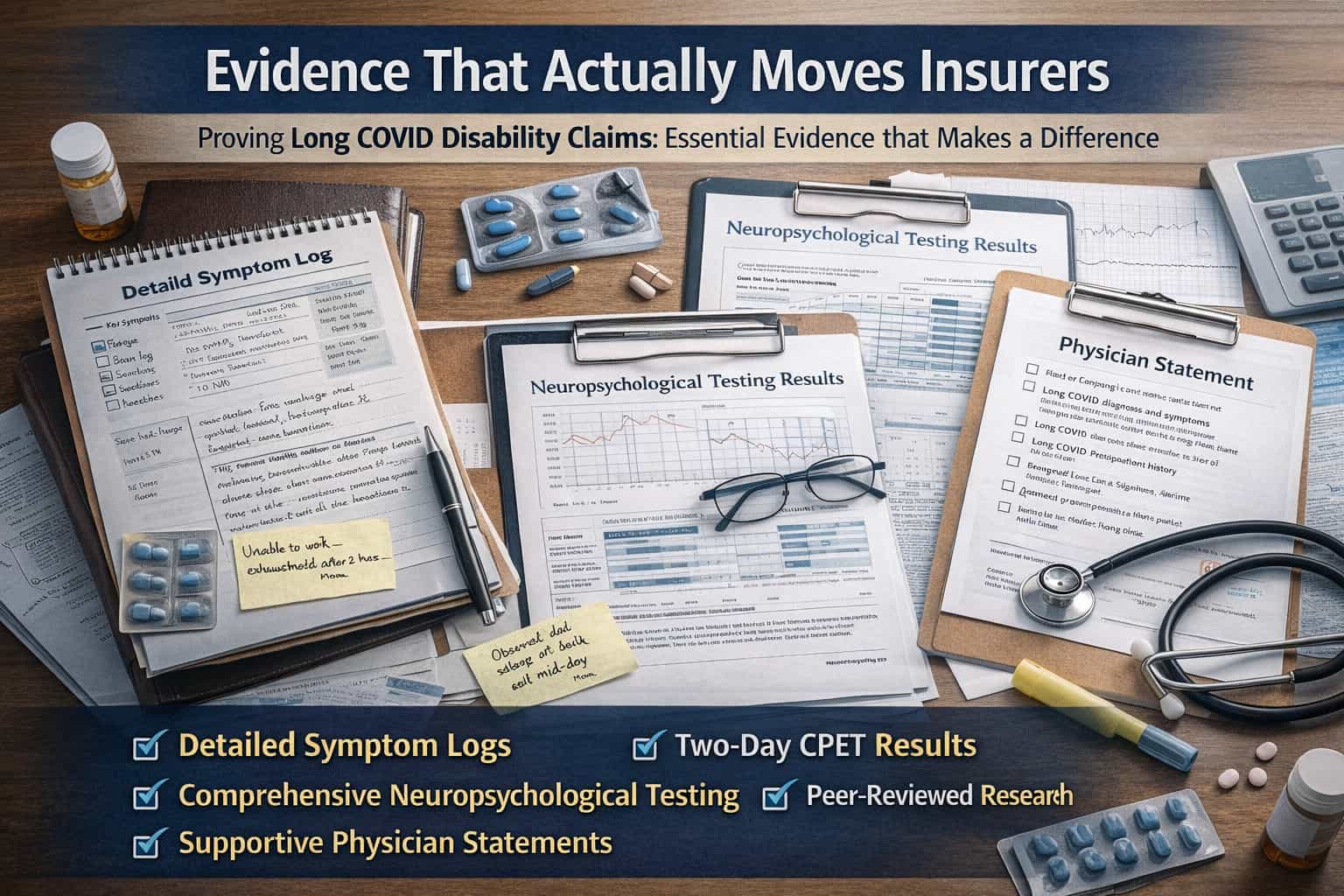
What evidence is required for Long COVID disability claims? Based on our extensive experience, here’s what actually makes a difference:
- Detailed Symptom Documentation: Keep meticulous daily logs tracking your symptoms, functional limitations, and how activities affect you. Record:
- Specific tasks you attempted and the resulting symptom flare
- How long symptom exacerbations lasted
- Activities you had to cancel or couldn’t complete
- Cognitive difficulties you experienced during work attempts or daily tasks
- Comprehensive Neuropsychological Testing: For cognitive impairment claims, formal neuropsychological testing by a qualified neuropsychologist is essential. Ensure the evaluation includes:
- Comprehensive battery assessing multiple cognitive domains
- Comparison to premorbid functioning (your abilities before Long COVID)
- Assessment of cognitive stamina and performance over time
- Functional implications for your specific occupation
- Supportive Physician Statements: Your treating physicians should provide detailed narratives explaining:
- Your specific diagnosis and symptom pattern
- How your symptoms meet recognized Long COVID criteria
- Functional limitations resulting from your condition
- Why you cannot sustain full-time work in your occupation
- The chronic, fluctuating nature of your condition
- Cardiopulmonary Exercise Testing (CPET): For appropriate candidates, a two-day CPET can objectively demonstrate post-exertional malaise by showing reduced performance on the second day of testing.
- Functional Impact Evidence: Document real-world functional limitations.
- Failed return-to-work attempts and what happened
- Activities of daily living you can no longer perform or must limit
- Accommodations you’ve tried that weren’t sufficient
- Testimony from family, friends, or colleagues about observed changes
- Peer-Reviewed Research: Include current medical literature about Long COVID, particularly studies demonstrating objective abnormalities, disability rates, and recognized symptom patterns.
How Kantor & Kantor, LLP Helps Clients Nationwide
At Kantor & Kantor, we’ve built our reputation over decades by fighting for people whose disability claims have been wrongfully denied. Long COVID claims have become a significant focus of our practice because we’ve seen how systematically insurers mishandle them.
Our approach combines experience with compassion:
- We understand the condition: Our attorneys have invested significant time understanding Long COVID’s medical complexities, research developments, and functional impacts. We speak the medical language and know how to present your case effectively.
- We know insurer tactics: We’ve seen every trick insurance companies use to deny Long COVID claims. We anticipate their arguments and build cases that preemptively address their likely objections.
- We gather compelling evidence: We work with you and your medical providers to assemble the strongest possible evidence package, including appropriate testing, detailed physician statements, and functional documentation.
- We handle nationwide claims: While based in California, we represent Long COVID disability claimants throughout the United States. ERISA law, which governs most employer-sponsored disability plans, is federal law, and we’re experienced in these claims regardless of where you live.
- We provide personalized attention: We know you’re not just a claim number. You’re a person whose life has been turned upside down by a debilitating condition. We treat you with the respect and compassion you deserve while aggressively advocating for your rights.
- We fight at every stage: Whether your claim was just denied, you’re facing benefit termination, or you need to file a lawsuit, we’re prepared to fight for you through every stage of the process.
Many of our Long COVID clients come to us after being denied by insurers who didn’t take their claims seriously. We’ve successfully overturned numerous wrongful denials and secured benefits for people who were told they didn’t qualify.
Frequently Asked Questions About Long COVID Disability Claims
Q: How long do I need to have symptoms before I can qualify for disability benefits?
A: Most disability policies require symptoms to last beyond the “elimination period” (typically 90-180 days). However, Long COVID symptoms often persist for months or years, easily meeting this requirement. The key issue isn’t duration—it’s proving that your symptoms actually prevent you from performing your job duties.
Q: Can my disability claim be denied because I had a “mild” COVID infection initially?
A: Absolutely not. There’s no correlation between initial COVID severity and Long COVID disability. Many people who had mild or even asymptomatic initial infections developed severe, disabling Long COVID. Insurance companies sometimes try to argue that a mild initial infection means you can’t be significantly impaired now, but this argument has no medical basis.
Q: What if my Long COVID symptoms fluctuate—I have good days and bad days?
A: Fluctuating symptoms are characteristic of Long COVID and don’t disqualify you from benefits. However, insurers often exploit this by focusing only on your better days. This is why daily symptom logs are so important—they document the pattern of good and bad days and show that even on better days, you likely can’t sustain full-time work.
Q: My doctor believes me, but the insurance company’s doctor says I can work. What now?
A: This is extremely common in Long COVID claims. Insurance companies hire doctors who conduct brief “independent medical examinations” (IMEs) and routinely conclude claimants can work. These opinions are often biased, based on inadequate examination, and ignore the treating physician’s longitudinal knowledge of your case. Your treating doctor’s opinion should carry more weight, and we can challenge biased IME reports by highlighting their flaws, the examiner’s lack of expertise in Long COVID, and contrary evidence from your actual medical records.
Q: I’m receiving short-term disability, but I’m worried about transitioning to long-term disability. What should I know?
A: The transition from short-term to long-term disability is a critical vulnerability point where many Long COVID claims get denied. Insurers often approve short-term benefits while expecting recovery, then deny long-term benefits by claiming you’ve improved or should be able to return to work. Start preparing for your long-term disability claim well before your short-term benefits end.
Take Action Today
Long COVID has already taken too much from you—your health, your career, your financial security. Don’t let an insurance company’s wrongful denial take your disability benefits, too.
Contact Kantor & Kantor, LLP today for a consultation. Let our experience and compassion work for you as we fight to secure the disability benefits you’ve earned and deserve. We represent Long COVID claimants nationwide and are ready to help you.
